
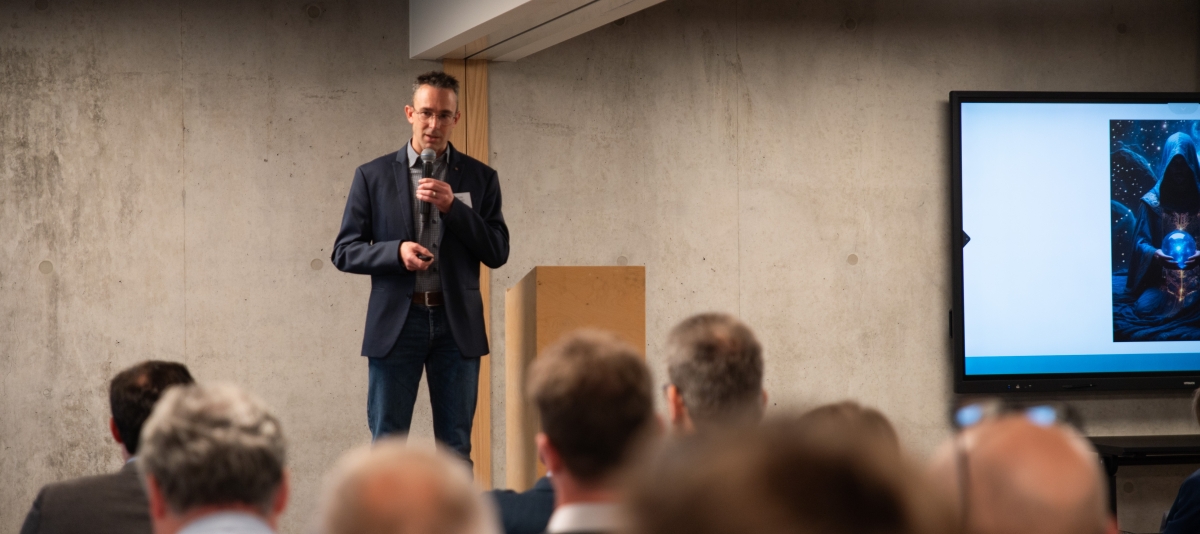
"It will take a lot more research and time before cultivated meat can conquer our markets." - Professor Lieven Thorrez
“It’s absurd to raise a whole chicken only to eat part of it afterwards.” This famous remark didn’t come from a scientist in the early 2000s. No, it was Winston Churchill who, as early as 1932, envisioned a future in which we would no longer be concerned with slaughtering a whole animal, but would focus instead on growing its separate parts. Consciously or not, Churchill thereby showed himself to be one of the founding fathers of ‘tissue engineering’, the production of cultivated meat.
In the spotlight: Professor Lieven Thorrez, Head of the Tissue Engineering Lab, KU Leuven
The first debates and insights into this science eventually emerged in the late 1970s, led by Professor Vandenburgh, who was researching how muscle tissue could be grown. The term tissue engineering finally appeared in scientific journals for the first time in 2005, along with what was then called cultured meat. But the phenomenon only really became known to the general public in 2013, when Mark Post pulled off a real stunt in London: according to him, the world’s first cultivated hamburger was a reality. The result was an avalanche of innovative start-ups…
The lab we set up at KULAK dates from 2012. Coming from a medical background, we try to make meat there to help people in the medical sector move forward. Now, almost fifteen years later, our insights have continued to evolve. But the industry behind it hasn’t stood still either. In 2024, around 3 billion dollars was invested in this ever-growing sector… While the industry is growing, regulation is only following in dribs and drabs. In the United States, a number of companies have received permission from the FDA (Food and Drug Administration) to take the next step. In Europe, a French company that makes foie gras has submitted an application to the European Commission, but so far the Commission hasn’t given permission to actually sell cultivated meat. In other words, our legislative framework isn’t ready yet for the commercialisation of cultivated meat.
But what exactly are we talking about when we talk about cultivated meat? According to the strict definition, it’s “a product made in a lab that cannot be distinguished from meat that comes from an animal.” At present, no product meets this definition. However, more and more hybrid products are appearing, with plant-based components to which some animal cells are added.
So what technology is actually behind cultivated meat? If we look at Mark Post’s first cultivated hamburger from 2013, it actually consisted of small pieces of white tissue made from a certain protein. Tens of thousands of them were made, brought together and pressed to form a hamburger. That hamburger didn’t look like much; it was white. But by adding things like beetroot juice, extra texture and other ingredients, it gradually started to look more like a hamburger. At the time, this made Post very optimistic: according to him, the hamburger could be commercialised on a large scale within three years at 11 euros each. Where he got that price and bold prediction from is unclear, but it looks very much like a random attempt to make things more tangible. The fact is that, a good 12 years later, the cultivated hamburger still isn’t on our shelves… And it looks like we shouldn’t expect it any time soon. There are still too many obstacles in the way.
First of all, to make cultivated meat, you need to get enough cells. In the lab, we’ve already managed to grow 10,000 cells into 1 million cells, the number needed for a good piece of meat. But we’re running up against our limits here, because in theory we can divide those cells in a lab environment, but once they’re taken out of the body, they lose some of their capacity to actually form muscle fibres. Another challenge is the search for the liquid needed to grow cells. That requires a certain serum for which we haven’t yet found an alternative. On top of that, you need equipment and a very sterile environment to scale everything up. A single bacterium can ruin the whole thing. And finally, maturation (the stage in which cultivated meat becomes real muscle meat) takes a lot of time. Time that investors often don’t have…
So you’ll understand that we’re not there yet with cultivated meat. It will take a lot more research and time before cultivated meat can conquer the market.
“HOWEVER, MORE AND MORE HYBRID PRODUCTS ARE APPEARING, WITH PLANT-BASED COMPONENTS TO WHICH SOME ANIMAL CELLS ARE ADDED.”


